A Costly Winter, or a Shield for the Chosen Few
9 December 2021
On 25 November 2021 Prime Minister Mateusz Morawiecki presented the assumptions of the so-called Tarcza Antyinflacyjna (the Anti-Inflation Shield), a package of measures intended to help curb the pace of price growth in Poland.

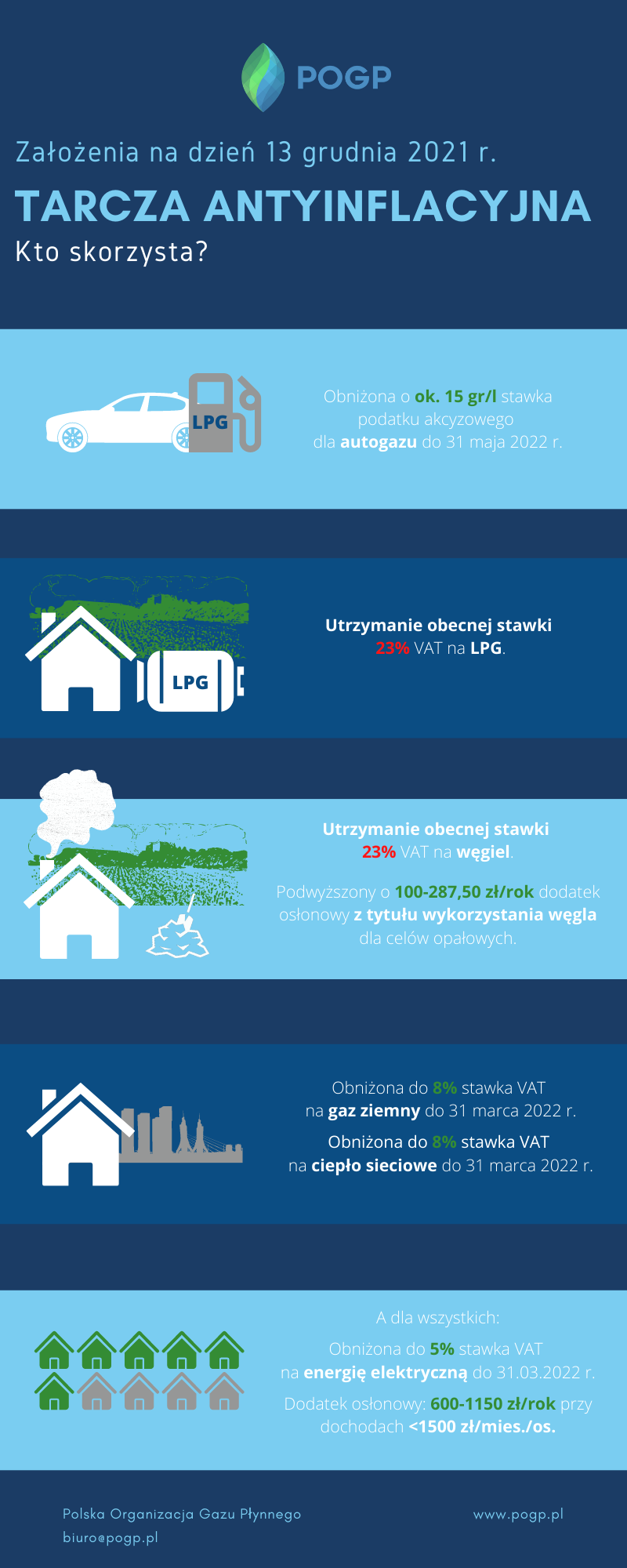
The package presented consists of three main pillars: a five-month cut in the excise duty rate on motor fuels, a reduction in the VAT rate on energy carriers used for heating purposes, and a shielding allowance for families.
Good news for drivers
As early as 30 November a government bill amending the Excise Duty Act and the Retail Sales Tax Act was tabled in the Sejm, writing the assumptions of the Tarcza Antyinflacyjna (the Anti-Inflation Shield) into the Excise Duty Act. The Polish Liquefied Gas Organization took part in the discussion on the assumptions of the bill and issued a favorable opinion on it, because it will make it possible to lower autogas prices in response to the unprecedented prices seen at filling stations. Until the end of May 2022 the excise duty rate on autogas will be PLN 387 per 1,000 kg (down from the PLN 644 per 1,000 kg in force in 2021), and sales of autogas and other motor fuels will be exempt from the retail sales tax for five months. That is good news for drivers.
Cheaper heating, but not for LPG users
Problems are raised, however, by the draft regulation of the Minister of Finance presented on 3 December, amending the regulation on goods and services for which the goods and services tax rate is reduced and on the conditions for applying the reduced rates (no. 451 in the list of legislative work of the Ministry of Finance). In view of rising energy prices and the approaching winter,
the Minister of Finance plans to cut the VAT rate on natural gas and district heating from 23% to 8% for two months (January-March 2022) and the VAT rate on electricity to 5%. At the same time, the Minister proposes to maintain the 23% VAT rate on liquefied gas (LPG).
In the view of POGP, excluding LPG used for heating from the regulation reducing VAT rates:
- discriminates against consumers in rural areas, who, having no access to grid gas, will be excluded from the operation of the Anti-Inflation Shield and over the winter will bear higher costs than homes connected to the gas network,
- contributes to sustained growth in food prices, because, alongside households, the most important consumers of liquefied gas are food producers – among them poultry farmers and greenhouse growers, for whom the cost of energy carriers is a significant component of production costs.
As early as 26 November, after the assumptions of the Anti-Inflation Shield were presented, POGP approached the Prime Minister of Poland and the Minister of Finance with a request to ensure equal treatment of liquefied gas and natural gas consumers. Following publication of the draft regulation on reducing VAT rates, we submitted our comments to the Ministry of Finance, once again intervening on behalf of citizens who use LPG for heating.
We hope that the Minister of Finance will decide to offer liquefied gas users a solution that protects them against inflation in the same way as households using the gas or district heating network.