The EPBD Directive Does Not Ban Boilers
14 March 2024
On 12 March the European Parliament backed the compromise on the content of the recast Energy Performance of Buildings Directive (EPBD), negotiated in December after a bumpy legislative path. Once it has been approved by the Council of the European Union, the new Directive will be published in the Official Journal of the EU and will enter into force. Contrary to sensational articles, it does not ban the installation of gas boilers.

The EPBD Directive aims to reduce greenhouse gas emissions and energy consumption by buildings across the EU. By setting requirements for newly built or renovated zero-emission buildings (ZEBs) it also defines which heat sources will be allowed to be installed in buildings meeting that standard. Since a great deal of imprecise information on the matter is circulating in the public debate, it is worth taking a closer look at the Directive.
Contrary to sensational media commentary, the EPBD Directive does not ban the operation of gas boilers
The vote of 12 March changed nothing in the content of the Directive, which we analyzed on our website not long ago from the perspective of installing gas boilers. The Directive does not ban the installation of boilers.
We welcomed with satisfaction the final shape of the provisions on the admissibility of installing heat sources in buildings. After a long discussion, the European Union has adopted an approach based on technology neutrality, which does not eliminate from buildings any of the heating technologies available on the market. The EPBD Directive allows Member States to choose the basket of solutions that best matches the needs of their societies – from the perspective of incomes, the quality of the building stock and climate conditions.
The EPBD clearly distinguishes heating boiler technology from fossil fuels, calling on Member States to phase out the latter and replace them with renewable fuels such as biomethane or biopropane.
The first step along this path will be the withdrawal, from 2025, of financial support for replacing heat sources with standalone - i.e. not combined with other heat sources - boilers powered exclusively by fossil fuels. It will still be permitted to offer financial incentives for hybrid systems with a significant share of renewable energy sources (RES), such as a combination of a gas boiler with a solar collector or with a heat pump. This means, for example, changes to the Clean Air program, which from then on could finance gas boilers only if they operate in combination with renewable energy sources.
In zero-emission buildings (new ones and those modernized after 2030) it will not be possible to use standalone boilers powered exclusively by fossil fuels, including coal, natural gas and LPG of fossil origin. Hybrid systems consisting of a gas boiler and other renewable sources (such as solar collectors or heat pumps) will still be able to be installed. In ZEBs it will also be possible to install boilers powered by renewable fuels, because under the provisions of the EPBD they will be treated in the same way as renewable energy sources installed locally.
The EPBD Directive also calls on Member States to draw up, by 2040, plans for withdrawing from the market standalone fossil fuel boilers, although this date is not binding. This approach can be illustrated by the example of the German market: under the heating act (GEG) passed in 2023, the share of bio-components in heating fuel should reach 30% in 2035, 60% in 2040 and 100% in 2045. After that, fossil fuels are to disappear from the German market altogether.
Consumers will not be forced to replace their boilers
The European Union has agreed on the gradual phase-out of standalone boilers powered by fossil fuels. By the end of 2024 the European Commission will issue guidance for Member States on what should be understood as a boiler powered by fossil fuels, although it will not be binding on the Member States. It should be expected that it will include a recommendation on the minimum share of bio-components that would allow a heating appliance to be excluded from the category of boilers powered by fossil fuels.
In the case of existing buildings, boiler users will not have to replace their heating system if it allows for the use of an increasing share of bio-components such as biomethane or biopropane. In the light of the EPBD Directive they will be treated on an equal footing with other heating appliances powered by renewable fuels, such as heat pumps.
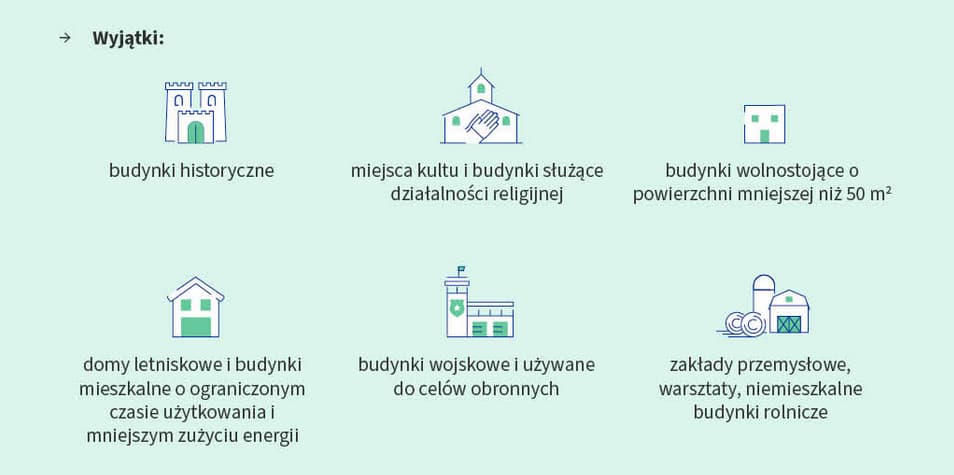
We also recall the exemptions from the provisions of the Directive for certain categories of buildings: holiday homes, historic buildings, places of worship, workshops and non-residential agricultural buildings or military buildings - these will not have to meet the criteria for zero-emission buildings.
In the course of the negotiations the Member States unequivocally rejected, on technical and financial grounds, the demand for the full electrification of heating in residential buildings. By maintaining technology neutrality and allowing different energy carriers for heating purposes, the EPBD Directive will make it possible to optimize the costs of the Union’s energy transition for consumers.
In the next step, the key question will be how the relatively flexible provisions contained in the Directive are transposed into national law, that is into the Act of 29 August 2014 on the energy performance of buildings.
Notification to the Office of Competition and Consumer Protection
In connection with the unprecedented flood of disinformation, the Polish Liquefied Gas Organization has filed with the President of the Office of Competition and Consumer Protection a notification of suspected practices infringing the collective interests of consumers, concerning untrue information about an alleged ban on the use of gas boilers. We trust that UOKiK will take an interest in unreliable press headlines intended to frighten consumers, of the sort "A financial penalty for using a gas boiler", "A ban on gas boilers" or "A ban on heating with coal and gas from 2025". Media messages of this kind are based on an attempt to exploit consumers’ fear in order to persuade them to buy alternative heating solutions, and this should be unequivocally condemned. We encourage readers to consult reliable sources on the heating of buildings, for example the website of Stowarzyszenie Producentów i Importerów Urządzeń Grzewczych (SPIUG, the Association of Manufacturers and Importers of Heating Appliances). We also recommend our February analysis of the provisions of the EPBD Directive.