Gas in Heat Pumps
15 December 2025
To say that the energy and heating sector faces regulatory challenges, resulting mainly from the European Union's adoption of the Energy Performance of Buildings Directive (EPBD) and from increasingly stringent technical requirements for buildings, is to say nothing at all. Gas heat pumps fueled with liquefied gas are a technology that combines high energy efficiency, scalability and full regulatory compliance with the WT2021 technical requirements, while minimizing dependence on an overloaded power grid.

Contrary to widespread disinformation, the EU regulations adopted to date do not eliminate gaseous fuels from the heating mix, but promote their integration with renewable heat sources. Gas Absorption Heat Pumps (GAHP) are a solution created for the modernization and supply of public-use facilities - including places of worship and administrative buildings - multi-family buildings and industrial installations, for which long-term operational stability and lower operating costs are the priority.
Unlike traditional electric heat pumps (EHP), gas absorption pumps eliminate the need for an energy-intensive electric compressor. Instead, a GAHP uses the combustion of gas (natural gas, LPG, biomethane) to drive an absorption cycle (most often an ammonia–water solution).
Thermodynamic absorption (ammonia-water)
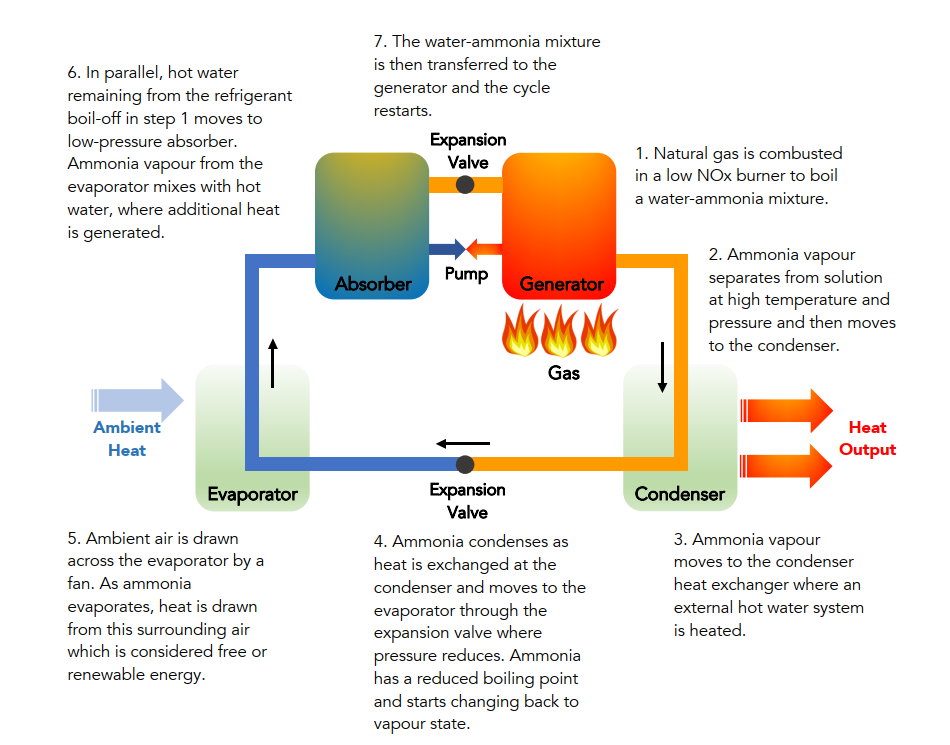
The key difference between the absorption cycle and compressor pumps is that mechanical compression is replaced by two stages: generation and absorption. The cycle is based on the absorption of a refrigerant (usually ammonia) by a transport medium (water).
The process begins in the generator, which is powered by thermal energy from the combustion of gas (including LPG). The heat supplied separates the refrigerant from the water. After condensation and a reduction in pressure, the ammonia passes into the evaporator, where it absorbs heat from the surroundings (air, ground or water), which constitutes the renewable energy input of the system. Then, in the absorption phase, the ammonia recombines with the water in a strongly exothermic chemical reaction. It is precisely this chemical and physical bonding of the compounds that releases a significant amount of heat into the heating circuit.
GAHPs need three energy sources in order to run the absorption cycle and transfer heat from the heat source to the heat sink:
- A renewable heat source in the environment: All heat pumps require a heat source in order to operate. That heat can be obtained from the surrounding air, from a water source or from the ground.
- Heat of combustion: the generator carries the ammonia and water solution, which is separated thanks to thermal energy from the combustion of natural gas, LPG or renewable gases. Absorption heat pumps can capture additional heat from the combustion process. This improves the overall efficiency of the system and makes them work
effectively in colder climates and less sensitive to low temperatures than compressor pumps. - Electricity: The absorption cycle does not require compressors to operate. Instead, the refrigerant circulates between the evaporator and the condenser by means of an absorber, a pump and a generator. Because a liquid is pumped rather than a vapor, the electricity required for pumping in absorption systems is minimal.
The absorption cycle makes it possible to achieve high efficiency and low sensitivity of GAHPs to low temperatures. Importantly, as a natural refrigerant, the ammonia used in GAHPs is exempt from the strict restrictions applying to fluorine compounds (F-gases), which have a very strong greenhouse effect and damage the Earth's ozone layer.
Minimal electricity consumption
Unlike compressor pumps, the electricity demand of a GAHP is reduced to a minimum - only to power the solution pumps and the circulation pumps.
This minimal dependence on the power grid matters wherever there are constraints on electricity connections.
- Infrastructure resilience: absorption pumps reduce vulnerability to possible power failures and make it possible to avoid having to increase the allocated electrical capacity, which can be problematic for some buildings - for example older churches in areas where the power grid is heavily loaded.
- Reduction in non-renewable primary energy consumption: the non-renewable primary energy factor (wi) for electricity generation is relatively high in Poland, and the minimal electricity consumption of GAHPs makes it possible to reduce that draw.
- Process heat in industry: today it comes mainly from the combustion of fossil fuels, so in order to reduce its carbon footprint, industry has to use sustainable heat sources. The prospect of replacing fossil fuels with hydrogen combustion is economically unrealistic today. In this context, absorption-based heat pumps may be a realistic solution allowing the environmental impact of industrial heat consumption to be limited.
Absorption pumps, designed for installation outside buildings, are adapted to run on both natural gas and liquefied gas. This provides flexibility in applications at locations far from natural gas infrastructure. Air/water models (GAHP-A) are capable of operating across a wide temperature range, even at -30°C, guaranteeing continuity of heat supply in all conditions.
Technical parameters
The advantage of GAHPs in the modernization of large facilities, including historic and industrial buildings, is their high efficiency and their ability to generate a high flow temperature. This limits the scope of the adaptation required to existing installations compared with low-temperature compressor pumps.
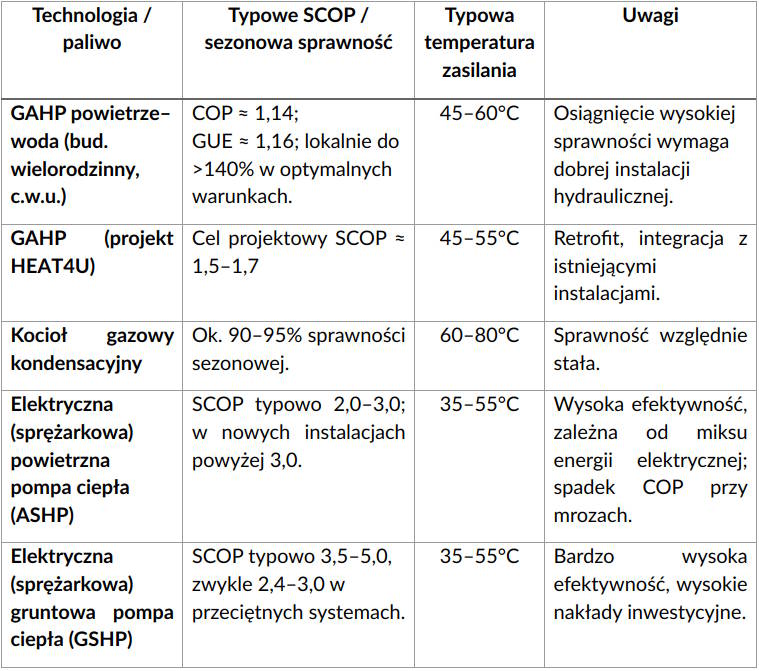
GAHPs typically provide a seasonal efficiency of 110–130% (SCOP 1.1–1.3) relative to the chemical energy of the fuel. Compared with a condensing gas boiler (about 90–95% efficiency) and with electric pumps (SCOP of 2.5 and above), gas pumps sit in the middle.
- High seasonal efficiency: absorption pumps are characterized by a high gross gas utilization factor, which is a measure of overall thermal efficiency. These devices achieve thermal efficiency exceeding 160%. Ammonia/water absorption-compression heat pumps have a maximum heat supply temperature of 160 °C and a temperature lift of up to 110 °C at an electrical coefficient of performance (COP) of 2.7–7.3.
- High-temperature generation: many older buildings have heating systems that were designed to work with high flow temperatures (above 60°C), typical of traditional heating boilers. Standard compressor heat pumps, which work efficiently at lower temperatures, usually require radiators to be replaced or enlarged. GAHPs remove that necessity. A similar situation occurs in industrial applications, where high temperatures are often required. The ability to produce high temperatures makes GAHPs an easy solution to deploy, ensuring a rapid return on investment through compatibility with existing infrastructure.
GAHP systems are highly scalable. For facilities with a large heat output they can be arranged in cascades, which allow several units to be combined at once, something that may be of particular interest to industry.
GAHP and renewable fuels
Gas absorption pumps are devices ready to use renewable gases. They can run on compatible fuels such as bioLPG or biomethane. bioLPG is the chemical equivalent of fossil liquefied gas obtained from renewable sources, so a change of fuel requires no modifications to the devices or to the storage infrastructure. With many manufacturers it is also possible to use an admixture of up to 20% hydrogen without upgrading the device. In this way, once an absorption pump fueled with liquefied gas has been deployed, the heat source can ultimately be changed to a fully renewable one simply by changing the product used.
Absorption pumps will be able to be used in zero-emission buildings after 2030 and are eligible for co-financing under the Clean Air program, provided that the specific devices are on the ZUM list.
Applications
Both monovalent systems, in which absorption pumps are the only heat source, and bivalent systems, in which a GAHP works together with condensing gas boilers acting as the peak source, are in use. Both devices then use the same fuel, which simplifies logistics.
GAHPs are already used in hotels, care homes, larger service buildings and in domestic hot water systems with a continuous load; sample pilot projects show that at an efficiency of about 113% for the GHP, the total efficiency of the system (GHP + boiler) reaches about 90%. When condensing boilers with an efficiency of about 90% are replaced, gas savings are typically 15–30% and the reduction in CO₂ emissions about 20–30%, depending on the share of the load covered by the GAHP.
In industry, GAHPs can operate as medium-temperature heat pumps (supplying low-temperature heating, heating process water, recovering waste heat), competing with electric heat pumps and high-efficiency boilers; the choice of technology usually depends on the gas/electricity price ratio and on the temperature requirements of the process.
Practical examples of heating projects using absorption heat pumps can be found, for instance, on the website of the company Gazuno, which also presented at the Forum Paliw Gazowych (the Gaseous Fuels Forum) in 2024.

Research conducted by Fraunhofer ISE (Fraunhofer Institute for Solar Energy Systems ISE) confirms the undiminished potential for using gas in modern heating. Under the LC R290 project, high-efficiency compressor heat pumps using propane as the refrigerant were tested with a view to replacing traditional heating systems in existing multi-family buildings. Under research conditions, a SCOP of about 3.6–3.8 was achieved for typical operating conditions in multi-family buildings. The project produced a replicable concept for heating systems based on propane-cooled heat pumps, which have the potential to become widespread in cities in the future, including in dense urban development. More about the project can be found on the institute's website.