Presentation of the POGP Annual Report for 2024
11 April 2025
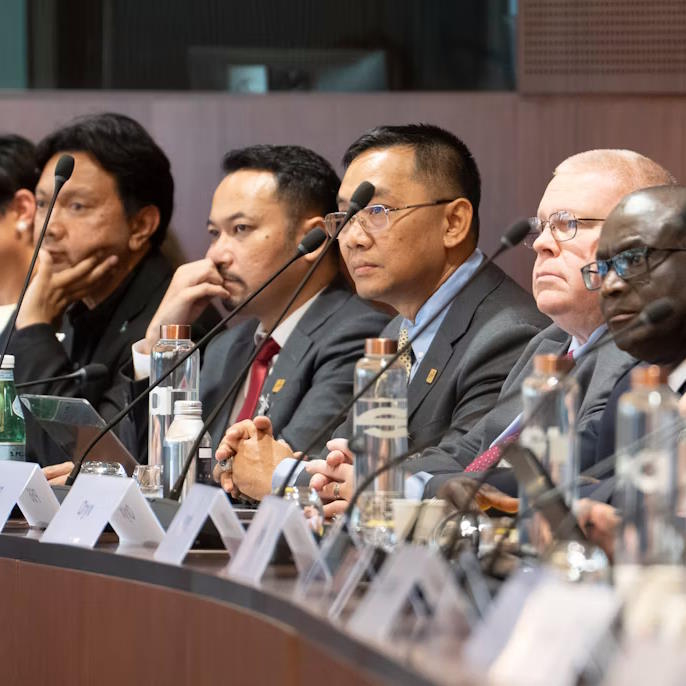
On 10 April 2025, a webinar of the Polish Liquefied Gas Organization featured a presentation of the data contained in the POGP Annual Report for 2024. The current situation on the LPG market was discussed by POGP guests - Przemysław Bryksa (KDCP), Lesław Żarski (URE) and Tymon Pastucha (PISM). Security of LPG supply is assured, and the standout market trend is the growing number of LPG tanks used to heat buildings.


Guests attending the webinar were welcomed by the President of the Polish Liquefied Gas Organization, Ewa Gawryś-Osińska. She then gave the floor to Bartosz Kwiatkowski, Director General of POGP, who presented the market data for 2024.
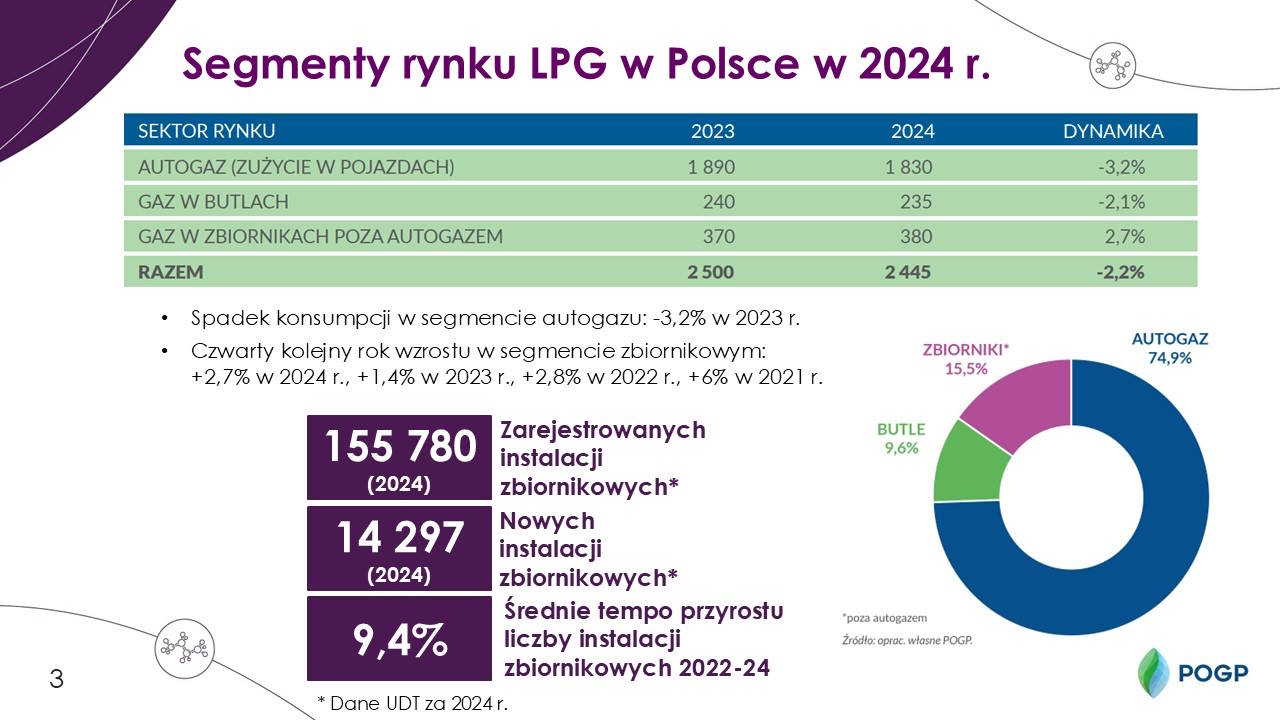
In the year preceding the effective entry into force of sanctions on LPG imports from Russia, the size of the market remained close to the level of previous years, and distributors ensured security of supply for the winter season. LPG consumption in Poland amounted to 2.45 million tons – only 2.2% less than a year earlier. Autogas invariably accounts for 75% of the market, the share of the bulk segment used to heat homes and production plants is growing, and the cylinder segment is continuing its decline for another year – this year to 9.6%.
In Poland, 2024 was marked by preparations for the entry into force of sanctions on liquefied gas of Russian origin. The end of liquefied gas imports from Russia under the European sanctions regulation is a symbolic closing of the period in which the Polish market depended on energy supplies from the east. Sanctions on LPG of Russian origin took effect on 20 December 2024, yet the market remained calm. Over the past year distributors prepared for the embargo, both by concluding contracts with new suppliers and by building up stocks. According to analysts’ data, fuel prices at filling stations, the largest segment of the Polish market, stabilized after the embargo entered into force at around PLN 3.20/l, unchanged from the closing weeks of the previous year. The mild winter helped to maintain market balance. In January and February no problems whatsoever were observed with supplies to liquefied gas users -
– said Bartosz Kwiatkowski.
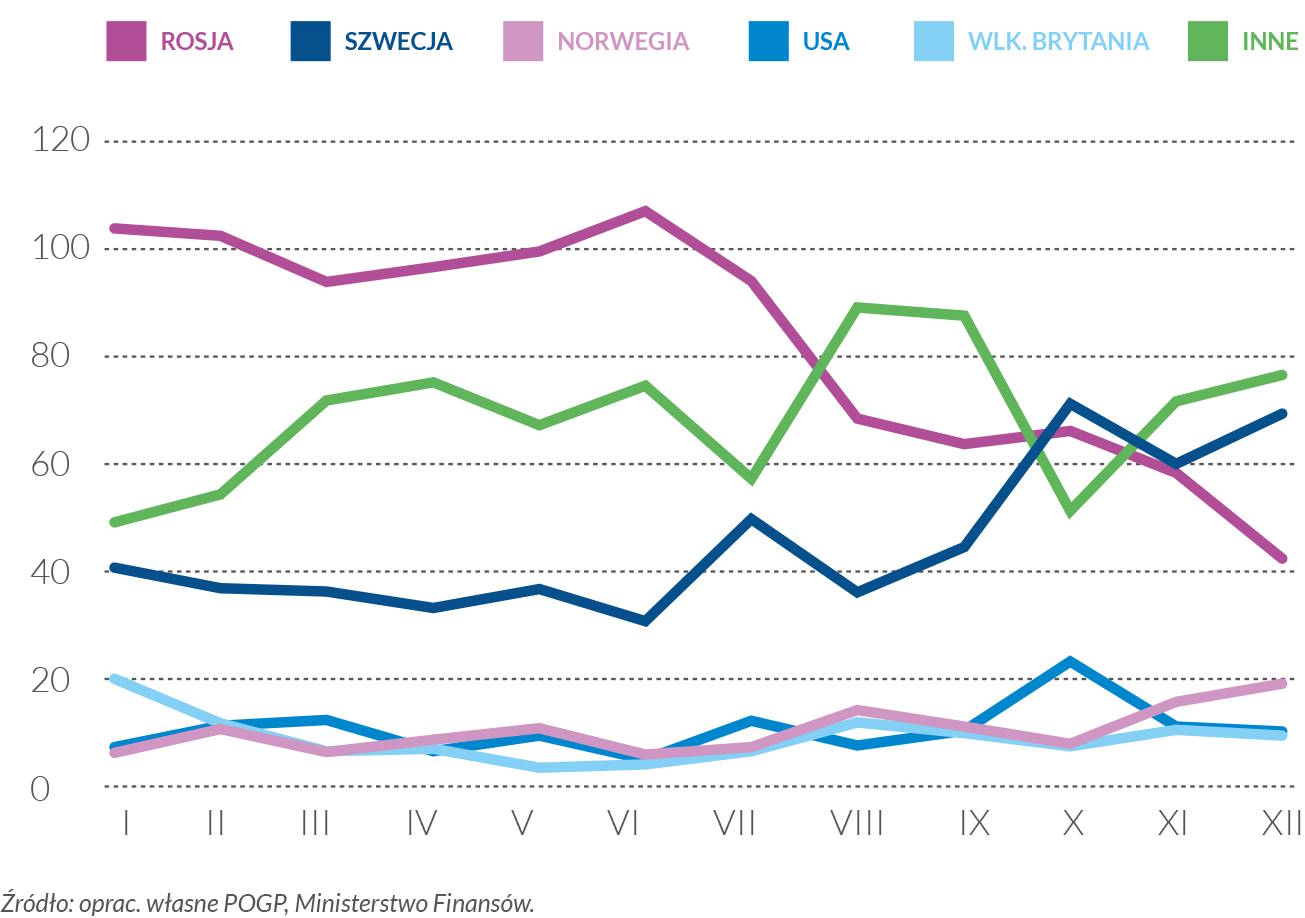
Across 2024 as a whole, the share of gas from Russia, which could still be brought in under contracts concluded before 19 December 2023, fell from 45.8% in 2023 to 42.7%, but in the final quarter of the year far faster diversification was observed. In December 2024 Sweden became the largest supplier of LPG to Poland, with a share of more than 34%, ahead of Russia (29.8%), Norway (10.9%) and the United States (5.2%). At the threshold of 2025, liquefied gas supplies to Poland were more diversified than ever before in history.
After two years of surging re-exports of LPG to Ukraine, driven by the invasion of February 2022 and by the cut-off of Russian fuel imports to the absorptive Ukrainian market, exports of liquefied gas from Poland fell by almost 40% last year. Thanks to investments carried out in Romania, including by Ukrainians themselves, it is that country which is increasingly taking over the role of the main source of supply of this fuel for our neighbors.
Poland plays a key role in the European LPG market. It is the largest autogas market in Europe, with more than 3 million vehicles running on liquefied gas, ahead of Italy. In 2024, 125,296 cars registered for the first time in Poland were recorded as having an LPG conversion system fitted, almost 3 times more than BEVs and PHEVs. Over the same period, 90,239 archival vehicles (so-called “dead souls”) were removed from the CEPiK database - vehicles for which no official action had been taken over the past 6 years, including taking out an insurance policy or passing a technical inspection.
It is worth emphasizing that in 2024 the number of LPG tanks used to heat buildings continued to grow rapidly – around 14.3 thousand new registrations were recorded, their number rose to 156 thousand, and the average annual increase in 2022-2024 was 9.4%. Given the mild winters of recent years, the number of heating installations powered by liquefied gas is growing much faster than fuel consumption for heating purposes. This is above all thanks to the ongoing replacement of the so-called “kopciuchy”, old solid-fuel stoves that are the single most important source of smog in sparsely urbanized areas, with modern condensing boilers. According to Polski Alarm Smogowy (the Polish Smog Alert), 2 million “kopciuchy” still account for 86% of total PM2.5 particulate emissions and for about 93% of carcinogenic benzo(a)pyrene emissions in Poland.
Bartosz Kwiatkowski also briefly presented the findings of the Ekobarometr 2024 survey concerning how Poles perceive LPG.
Przemysław Bryksa, representing the KDCP law firm, then presented a concept for amendments to the stockholding act. The system of mandatory stocks in Poland, whose framework was designed in 2007, requires changes, and this meets with broad understanding both on the part of public administration and on the part of businesses. One of the proposed directions is to transfer 100% of the obligation to physically maintain LPG stocks to the state, with the costs of those activities borne by businesses.
Lesław Żarski, Director of the Liquid Fuels Market Department at the Energy Regulatory Office, in turn presented the regulator’s perspective on the phenomena observed in the LPG market. Director Żarski discussed trends in the number of licenses for trading in liquid fuels and in the structure of licensees’ activities - at the end of 2024, alongside filling stations and gas retail outlets, Poland had 146 gas bottling plants and 782 entities engaged in mobile gas sales. He concluded by announcing that URE plans to change the threshold below which an entity selling gas is exempt from the licensing requirement - the proposal assumes abandoning the EUR 10,000 threshold in favor of a weight limit of 60 tons of gas in cylinders per year.
Finally, Tymon Pastucha, an analyst at the Polish Institute of International Affairs, discussed the geopolitical context of the sanctions on liquefied gas imports from Russia. As a result of the sanctions imposed by the European Union and the United States, Russian revenues from fossil fuel exports fell over 2021-24 - both in real and in nominal terms. At present, all Russian revenues from hydrocarbon exports are being channeled into military spending. PISM estimates the annual financial losses from the European embargo on LPG at around USD 1 billion, and, with the sanctions entering into force in December 2024, the price of liquefied gas on the domestic market in Russia collapsed, while exporters looked for new outlets and for ways to circumvent the embargo. In 2025 Russian LPG is entering Europe to an increasing extent in the form of n-butanes excluded from the embargo and as mixes - after being mixed in third countries.
We invite you to read the POGP Annual Report for 2024!