SNG to the Rescue of Industry
26 February 2024
Security, certainty and stability of supply, and continuity of the process - these are the fundamental conditions that must be met by any energy source powering a company's production processes. The volatility and uncertainty that currently characterize the global energy market have forced businesses to reorganize their business models. Being prepared for various scenarios and having a safeguard in the form of an alternative energy source is becoming a standard that market leaders aspire to. One solution that meets these criteria is synthetic natural gas (SNG), produced by mixing the vapor phase of liquefied gas (LPG) with air. Mixing with LPG mixers yields a product whose calorific value is identical to that of natural gas, which makes it possible to supplement or entirely replace the source powering a process. As a universal energy source, SNG is gaining popularity and may become the answer to the needs of many branches of Polish industry.
The energy crisis triggered by Russia at the turn of 2021 and 2022 exposed the weaknesses of European energy security. Natural gas prices reached a record level of 345 EUR/MWh. European countries hurriedly began looking for new suppliers, and EU member states were also placed under an obligation to fill their storage facilities before the winter season.
The crisis also resulted in curtailed operations in some branches of European industry, especially the energy-intensive ones (metallurgy, chemicals and food processing). In 2022, industrial output of products such as aluminum, steel and fertilizers fell by 8%. An important lesson from the energy crisis appears to be a new dimension of risk management at plant level, namely the diversification of energy sources. Many management boards have realized that having a backup solution in case of interruptions in the supply of regulated energy carriers may be a necessity.
How to replace natural gas?
One answer to constraints on natural gas supply may be LPG mixers (blenders), which gained popularity in 2022. Initially used and designed as a reserve for a company's energy supply system, they quickly proved their business value by significantly reducing energy costs. At the same time, LPG mixers can eliminate the risk of downtime and ensure production continuity even in the event of administrative restrictions on natural gas supply. Several companies specializing in the distribution and installation of this type of equipment currently operate in Poland, among them members of the Polish Liquefied Gas Organization: FAS Poland, GOK Polska, I-Maximum and ITGAS.
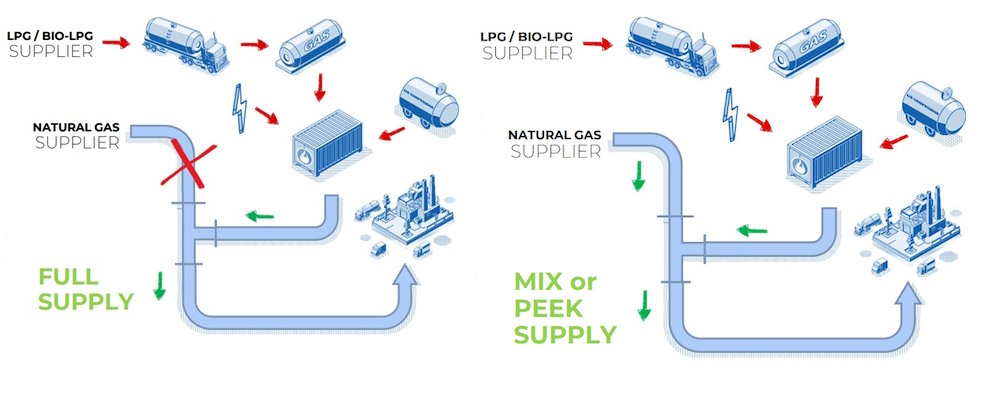
Mixers and complete synthetic natural gas (SNG) systems can be used to supplement or entirely replace pipeline natural gas in order to manage downtime and supply interruptions, or to take advantage of price differences between various types of fuel. In the face of today's challenges this is absolutely crucial.
comments Piotr Urbański, Branch Manager at GOK Regler und Armaturen Polska sp. z o.o.
A properly designed LPG mixer installation that meets the highest standards helps reduce gas consumption without lowering the performance of the entire system. As a result, an investment in such an installation can quickly pay for itself.
Seeking savings in industry is very important, but it cannot come at the expense of production quality or efficiency. Using liquefied gas in industry makes it possible to cut costs significantly, and thanks to the high-quality components used to build the gas installation, gas consumption can also be reduced
adds Kamil Komornicki, co-owner of ITGAS Inter Tech Gas.
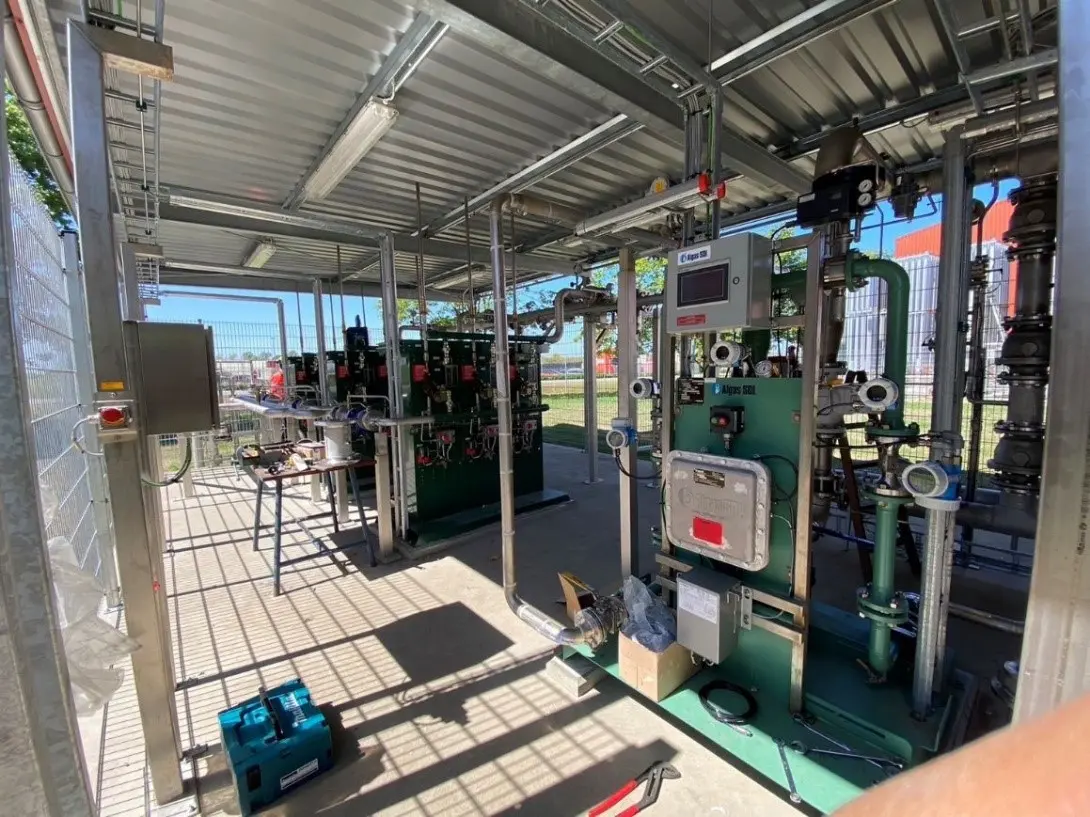
Deploying LPG mixers at plants that have so far been powered by natural gas requires an additional installation. Given that the LPG vapor phase produced in the vaporizer is not physicochemically identical to natural gas, a gas mixture with parameters appropriate for the given system has to be produced. This allows users to switch smoothly from a supply of natural gas delivered through the distribution network to a system based on liquefied gas. During the changeover procedure there is no need to alter burner or boiler settings, which makes this solution convenient from the operator's point of view.
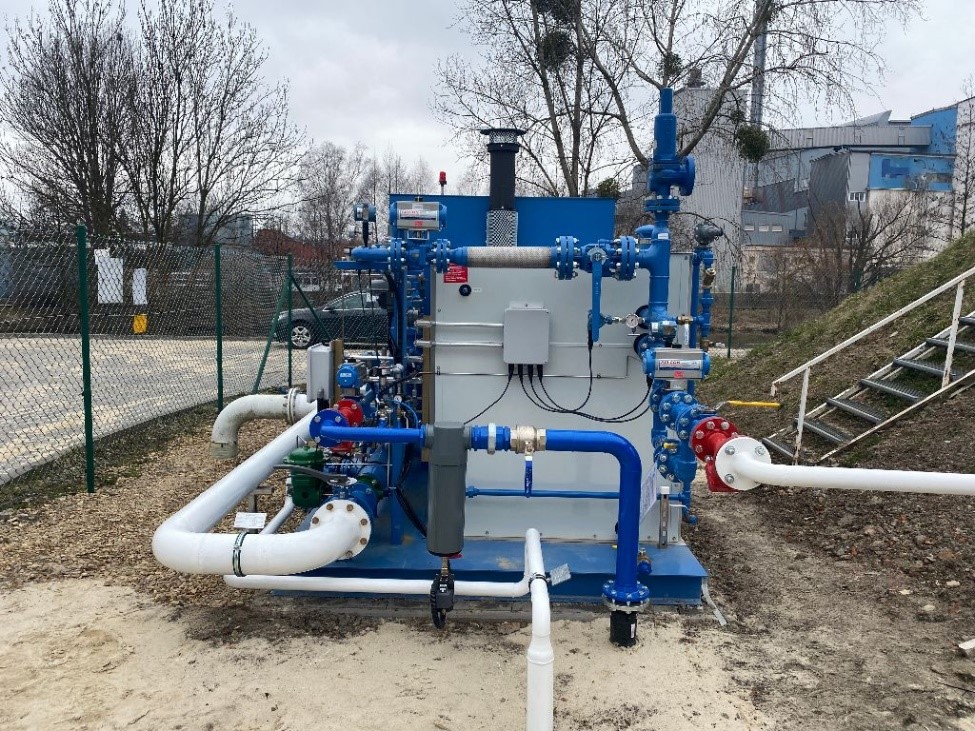
How does an LPG mixer work?
LPG mixers make it possible to mix liquefied gas with air, thereby creating a mixture called synthetic natural gas (SNG). There are essentially two main types of blenders:
- LPG/SNG blenders based on the Venturi principle;
- LPG/SNG blenders using an adjustable piston system.
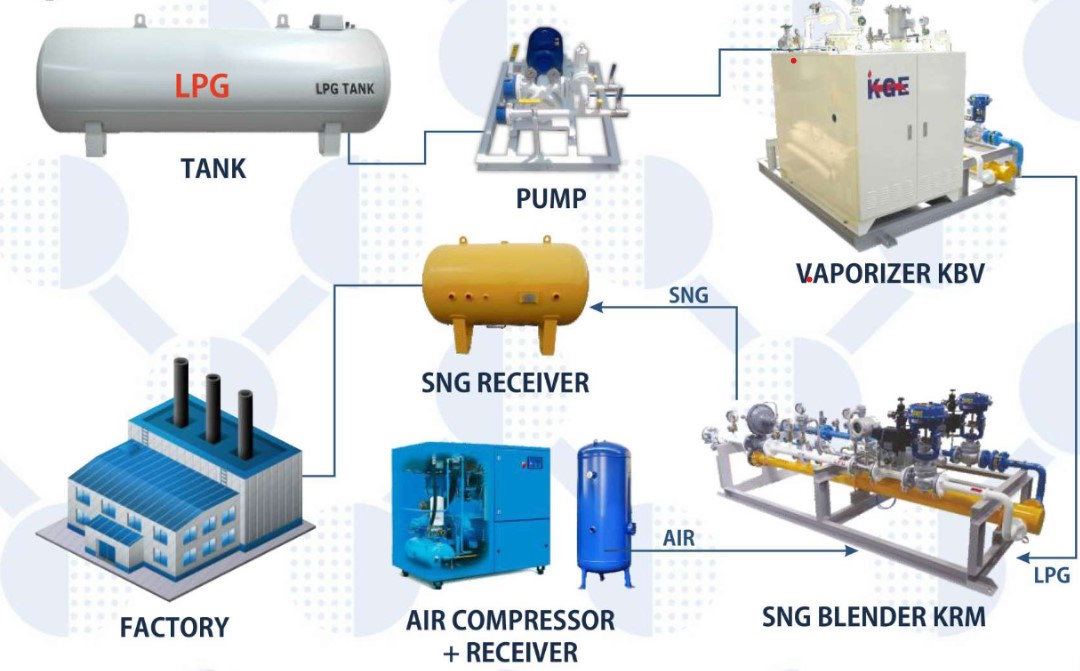
Regardless of the technology used, the process of producing SNG is essentially identical and consists in mixing the vapor phase of liquefied gas (LPG) with air. Blending produces a mixture whose calorific value is identical to that of natural gas. It can therefore be used in installations as a direct substitute for natural gas, with no need for technological changes, reconfiguration or nozzle replacement.
The LPG mixer itself is only one element of a larger system, whose remaining components are propane (LPG) tanks, a pump (single or double), a liquefied gas vaporizer, an air tank, an SNG tank (buffer) and a compressor.
The technology in practice
Blender technology itself is not new; companies have been using it since the 1950s. During the energy crisis, and because of the uncertain situation on the gas market, it has been enjoying a renaissance.
Mixers can be used in various branches of industry, including:
- the chemical industry,
- the food industry,
- the metallurgical industry,
- the glass industry and many others.
The circumstances in which natural gas customers may need an installation for producing synthetic natural gas (SNG) are explained by Świętosław Kariuk, Sales Manager at I-Maximum sp. z o.o.:
It is used above all in the event of natural gas pressure drops, exceeded consumption limits, undelivered ordered volumes of natural gas, or a fall in calorific value (quality parameters). If an interruption in gas supply occurs, SNG can be used as an alternative energy source.
SNG mixers have found wide application in glassworks, among other places. In one of the examples presented by suppliers, a company bound by long-term contracts for natural gas supplies at fixed prices decided to invest in an LPG/SNG mixer in order to increase flexibility and balance its energy costs. The investor originally planned to use the LPG/SNG mixer as a backup installation, but because of favorable price conditions and stable supply it decided to use the mixer permanently and to consume fuel in a ratio of 50% SNG to 50% natural gas in order to fulfill the contract. By switching to an LPG/SNG mixer the company recorded substantial savings. Before the investment, the company consumed 36 thousand MWh of natural gas per month at a cost of about PLN 20.5 million. After the investment, with the mixer operating in a 50% natural gas and 50% LPG mode, the monthly cost of liquefied gas came to PLN 4 million.
According to the German liquefied gas association DVFG, German demand for LPG in the industrial sector rose by almost 30% in 2022 compared with the previous year. Order books for propane-air mixing systems, which allow users to replace natural gas in whole or in part, grew sharply. The new group of LPG customers comes from a range of sectors, from food processing through glassworks to metallurgical plants and manufacturers of hygiene products. One Polish glassworks reports that its December 2022 investment in an LPG mixer paid for itself within three months – the company returns to natural gas when that becomes the cheaper option, but thanks to the infrastructure it already has it can switch back to LPG within 24 hours if needed.
As Konrad Kowalski, Business Development Manager at FAS Poland, notes:
Many customers are now wondering what the point of investing in this solution would be, given that the situation on the natural gas market is stable again. We point out to our customers that the ability to anticipate crises, rather than react to them, is the key to success. The current energy situation remains particularly risky for all entities that do not have diversified energy sources.
Summary
SNG mixers are a technology that increases a company's potential by providing an alternative energy source for production processes. They also reduce the risk of production downtime, and in the event of an interruption in natural gas supply they can act as a backup installation powering the entire technological process. They ensure continuity of operations, which is particularly important for companies for which halting production may mean permanent damage to their installations or heavy losses. Thanks to the freedom to choose their liquefied gas supplier, companies can negotiate competitive prices, which over the longer term translates into substantial financial savings. Under particularly favorable conditions, an investment in an LPG mixer alone can pay for itself within as little as three months. The fuel used by the mixers is subject to smaller price fluctuations than natural gas.
Synthetic natural gas (SNG) produced with LPG mixers is an attractive alternative for industry because:
- it provides a gas with physicochemical parameters equivalent to those of natural gas,
- the investment involves low risk and low costs,
- synthetic natural gas (SNG) is a multi-purpose energy source that is easy to produce at plant level.