Autogas, a Polish-Italian specialty
1 September 2025
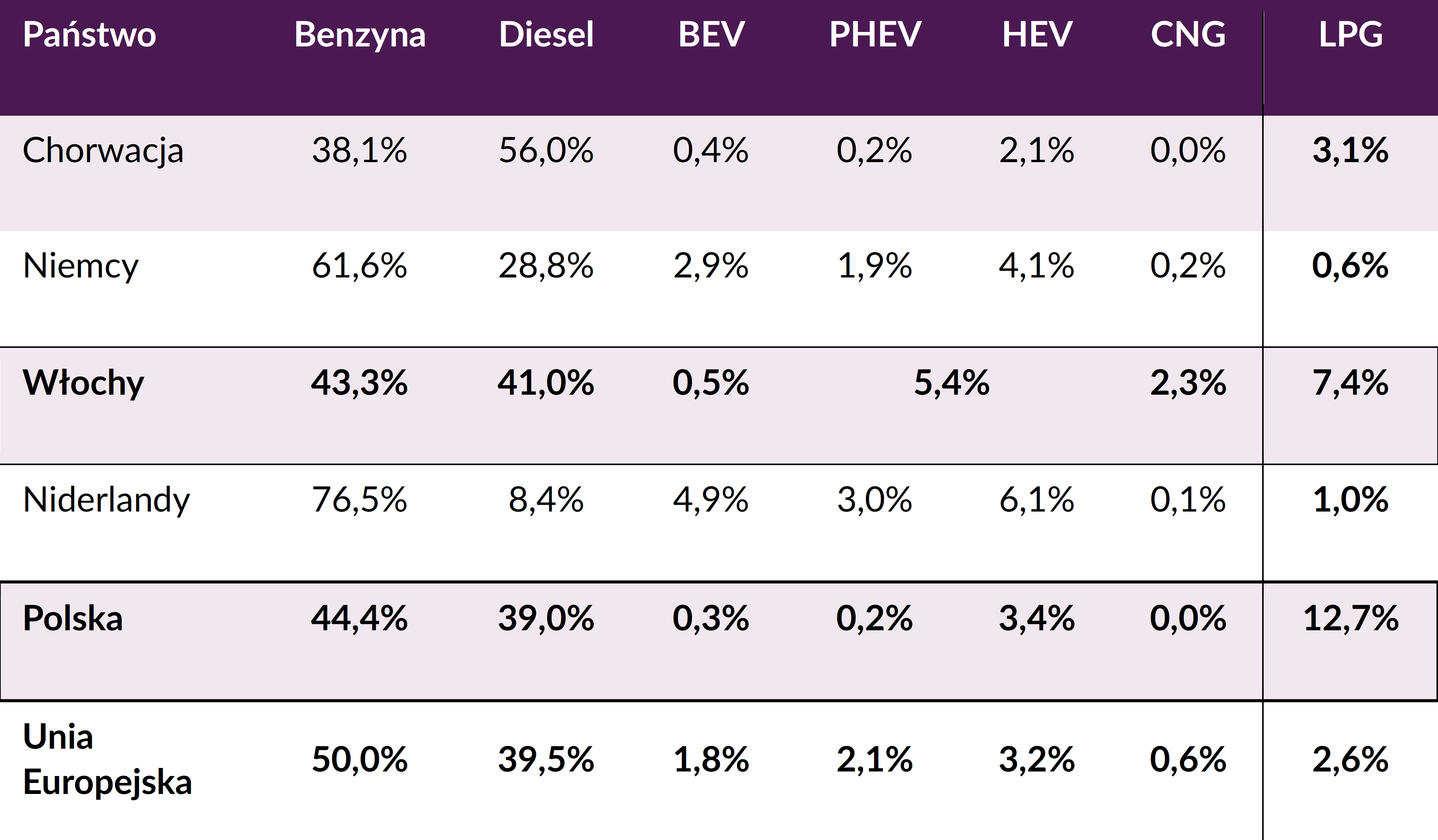
What links the Polish and Italian car markets against the wider European Union backdrop is the popularity of autogas, that is, liquefied gas (LPG) used to power cars. Together, these two countries account for ¾ of all autogas-powered cars registered in the European Union.

The Italian car market is the second largest in the European Union, after Germany, with more than 41 million registered passenger cars. Next in line are France (39.5 million), Spain (26.7 million) and Poland (22.3 million). Italians, however, lead in the number of cars per 1,000 inhabitants (694), while the average age of a passenger car on the Apennine Peninsula is 12.8 years – less than in Poland (15.1) and across Central and Eastern Europe, but still high compared with Western Europe. The high density of cars in cities contributes to the air quality problem, an issue shared by Italy and Poland. According to the European Environment Agency, of the 100 EU cities with the worst air quality, 37 are in Italy and 34 in Poland.
According to Eurostat, in 2024 there were 3.1 million autogas-powered cars registered in Italy, which accounted for about 7.5% of the entire vehicle fleet and nearly half of all cars running on alternative fuels (including hybrid drivetrains). In the same period, as we wrote in the Annual Report, in Poland the number of gas-powered vehicles reached 3.5 million according to Statistics Poland (GUS) data, and around 125,000 new LPG conversion systems were registered.
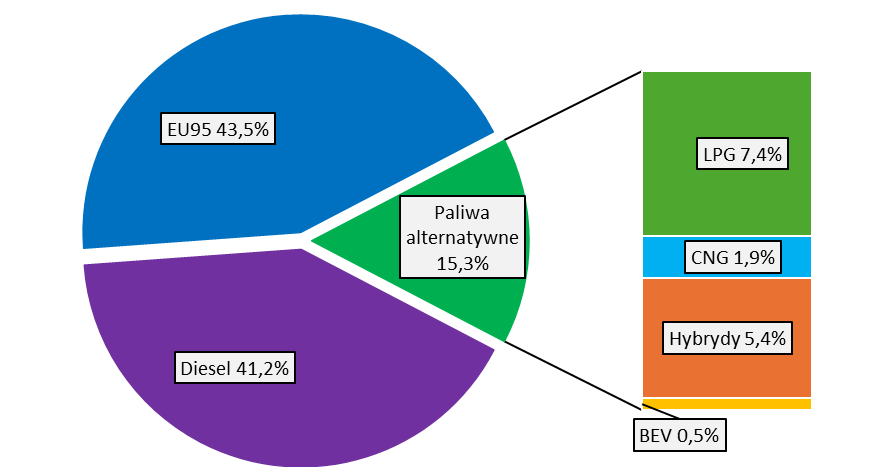
The share of LPG cars in the Italian new car market exceeded 9% in 2024, which means that the share of autogas in the car fleet is growing. This trend confirms consumers’ positive attitude toward a fuel that combines environmental benefits with savings in day-to-day use. As in Poland, the most popular brands of LPG-powered cars were Renault and Dacia, with the Sandero, Duster and Captur models dominating registrations.
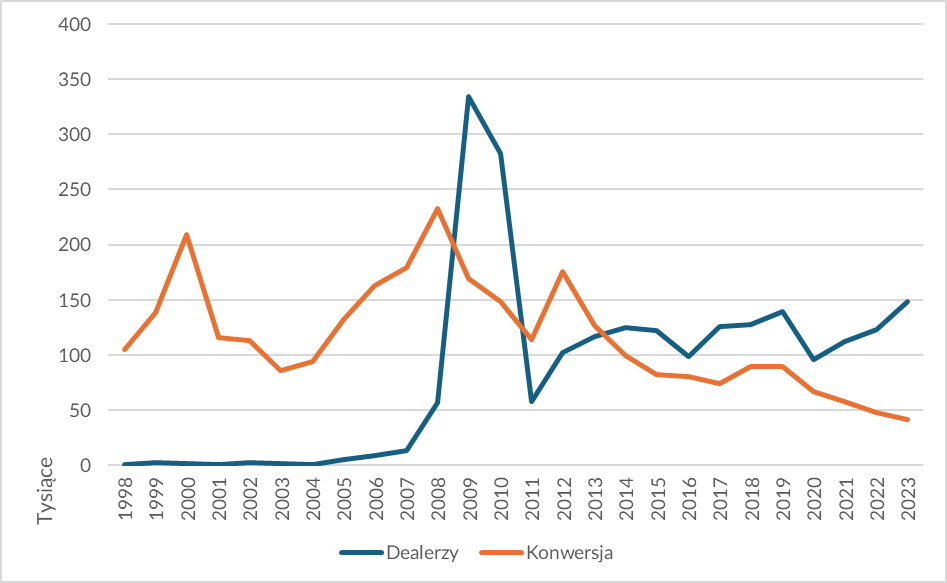
What sets the Italian autogas market apart from the Polish one is the ratio between new car registrations and conversions. Poland is Europe’s largest conversion market, that is, the market for fitting LPG conversion systems in gasoline cars. Italy, in turn, is the largest market for new cars with factory-fitted LPG systems. On the Apennine Peninsula, factory-fitted systems have dominated for a decade and in 2023 they reached almost an 80% share of registrations. Over 10 years, the number of conversions fell by 76%, to about 40,000 units per year.
In Poland the proportions are the reverse: about 80% of LPG system registrations in the Central Vehicle Register are used cars, which their owners retrofitted with a gas installation and legalized by officially reporting the conversion. In Poland, over the past 25 years, a dynamic branch of industry has grown up around the manufacture of vehicle gas fueling systems, one that competes successfully on the global market with older companies from the Netherlands and Italy.
Drivers of autogas growth in Italy
A fund for environmental protection in transport had operated in Italy since 1998, supporting the development of low-emission mobility. It financed, among other things, subsidies for vehicle conversion when gas systems were fitted, both for autogas and for compressed natural gas (CNG). In the case of autogas the subsidy amounted to EUR 350 and was paid directly to the workshop for the service performed. In 2007, 10 years after the fund was set up, the rate was raised: a driver who decided on a conversion could take advantage of a EUR 500 discount when a gas system was installed.
In 2009-2010 Italy additionally implemented a grant program for the purchase of passenger cars running on autogas and CNG. The main aim was to accelerate the green transition in transport – LPG and methane are cleaner fuels than gasoline because of their composition. In use they are characterized by lower emissions of particulate matter and other pollutants. From an economic point of view LPG was also a cheaper fuel for consumers, so the subsidy program had a cost-saving dimension and met with strong consumer interest.
At that time a bonus of EUR 1,500-2,000 was offered on the purchase of a new car, on condition that the old car was scrapped. It took the form of a discount off the dealer price, until the budget set for the program was exhausted (EUR 102 million in 2009 and smaller amounts in the following years, about EUR 11.5 million and EUR 24.8 million respectively).
The program proved a huge success in popularizing autogas in Italy. In 2009-2010 the replacement of cars was so popular that, given the cost of the program, in 2011 the funds were shifted entirely to the conversion program. In 2009, 350,000 new LPG-powered cars were sold on the Apennine Peninsula, and a year later about 270,000, making Italy the largest market for new LPG cars in Europe. After 2010 sales of new cars fell, but the long-term effect of the subsidies was to entrench the popularity of gas as a transport fuel in the following years as well. The program created lasting foundations for the autogas market in Italy — before 2009 the share of LPG cars in new registrations was 2-3%, during the program it tripled, and in subsequent years it held at around 5%. In the Italian government’s assessment, as a result of the LPG subsidy program the average CO₂ emissions of new cars registered in Italy fell from 144.7 g/km in 2008 to 136.3 g/km in 2009, moving closer to the EU target, and this was one of the best results among EU member states.
After the temporary crisis of the pandemic years, sales of new LPG cars in Italy rose again to about 150,000 units per year. What matters most to Italian consumers is cost – both in terms of the fuel price and of the possibility of benefiting from exemptions from traffic restrictions, in particular those relating to the so-called Clean Transport Zones. Gas-powered vehicles are usually covered by exemptions from traffic restrictions based on EURO standards. Cities offering such exemptions for LPG include Bergamo, Florence, Genoa, Milan, Naples and Venice (provided that the car actually runs on gas in the city), among many others. In recent years numerous Italian cities have adopted anti-smog resolutions – these usually allow gas-powered cars to enter provided they are approved for road use.
In response to the decline in LPG conversions of used cars, in 2024-2025 the Italian government once again offered citizens a subsidy program aimed at reducing the emissions of the existing car fleet, the so-called Ecobonus – Retrofit. The Ministry of Enterprises introduced funding of EUR 400 for LPG systems in category M1 cars meeting the EURO4 standard or higher. As with the instrument implemented from 1998 onward, the funding is directed to the workshop carrying out the installation. The new program is treated as an industrial policy instrument supporting the domestic automotive industry – including small and medium-sized enterprises.
Presenting the program, Minister Adolfo Urso said:
This new incentive plan for the automotive sector rests on three pillars: renewing the car fleet in Italy, one of the oldest in Europe; supporting demand among lower-income people; and reviving vehicle production in Italy. This approach is based on the conviction that a profound change of course is needed compared with previous years.
Prime Minister Meloni’s government has adopted a more active industrial policy than its predecessors, also seeking to protect the interests of the domestic automotive sector.
The Polish and Italian autogas markets were discussed during May’s Europejski Kongres Gazu Płynnego (the European Liquefied Gas Congress) by Paweł Baraniuk, Vice-President of AC SA, and Bartosz Kwiatkowski, Director General of POGP.
Photo by Bianka Bécsi: https://www.pexels.com/photo/colorful-italian-street-with-cars-and-pedestrians-33579771/